

THE PUNCH PEOPLE • INTERVIEW
John & Cynthia Hardy
Co-Founders of Bambu Indah
Interview by The Punch
Photography by The Punch & Bambu Indah
Published 2026
Most hotels are built to a plan. A site is cleared, a slope is levelled, and the same room is repeated a hundred times. Bambu Indah was never meant to be a hotel at all. John and Cynthia Hardy bought the land beside their home on the Sayan ridge so that no one else would build on it, and they were happy to leave it empty for years. When their guests outgrew the house, they brought in antique Javanese bridal houses, and an accidental hotel was born.
Twenty years later, Bambu Indah has become a learning lab for regenerative hospitality. Its buildings stand off the ground, its pools are fed by springs, and the word "luxury" has been banned. The Hardys came to Bali in 1975 and 1982 and went on to found Green School. Here they talk about what they saw in century-old teak, why sustainability is no longer enough, what bamboo has taught them, and the inconvenient joys of living close to nature. They also return to the question they have been asking for two decades: how can the Bali they fell in love with last?
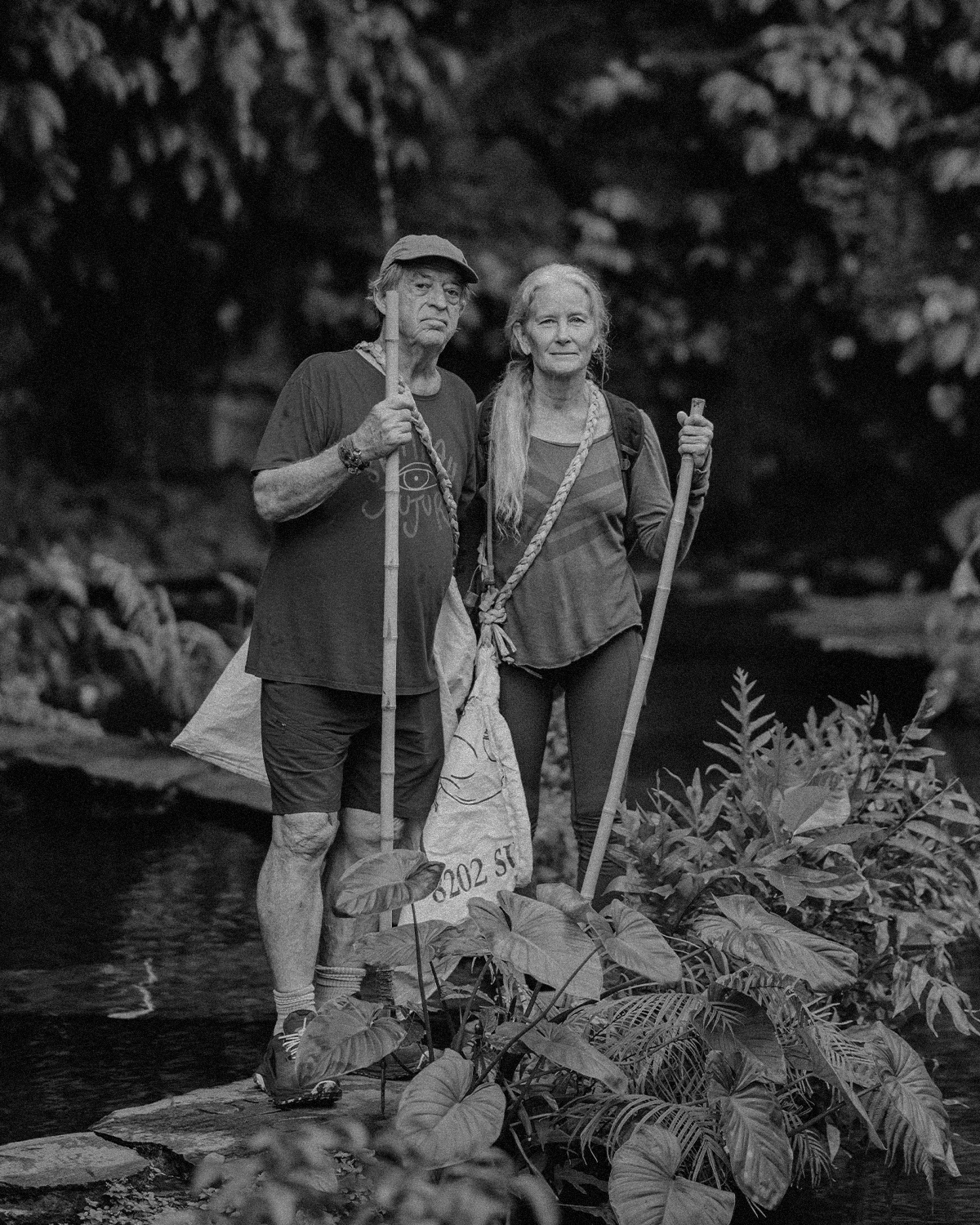

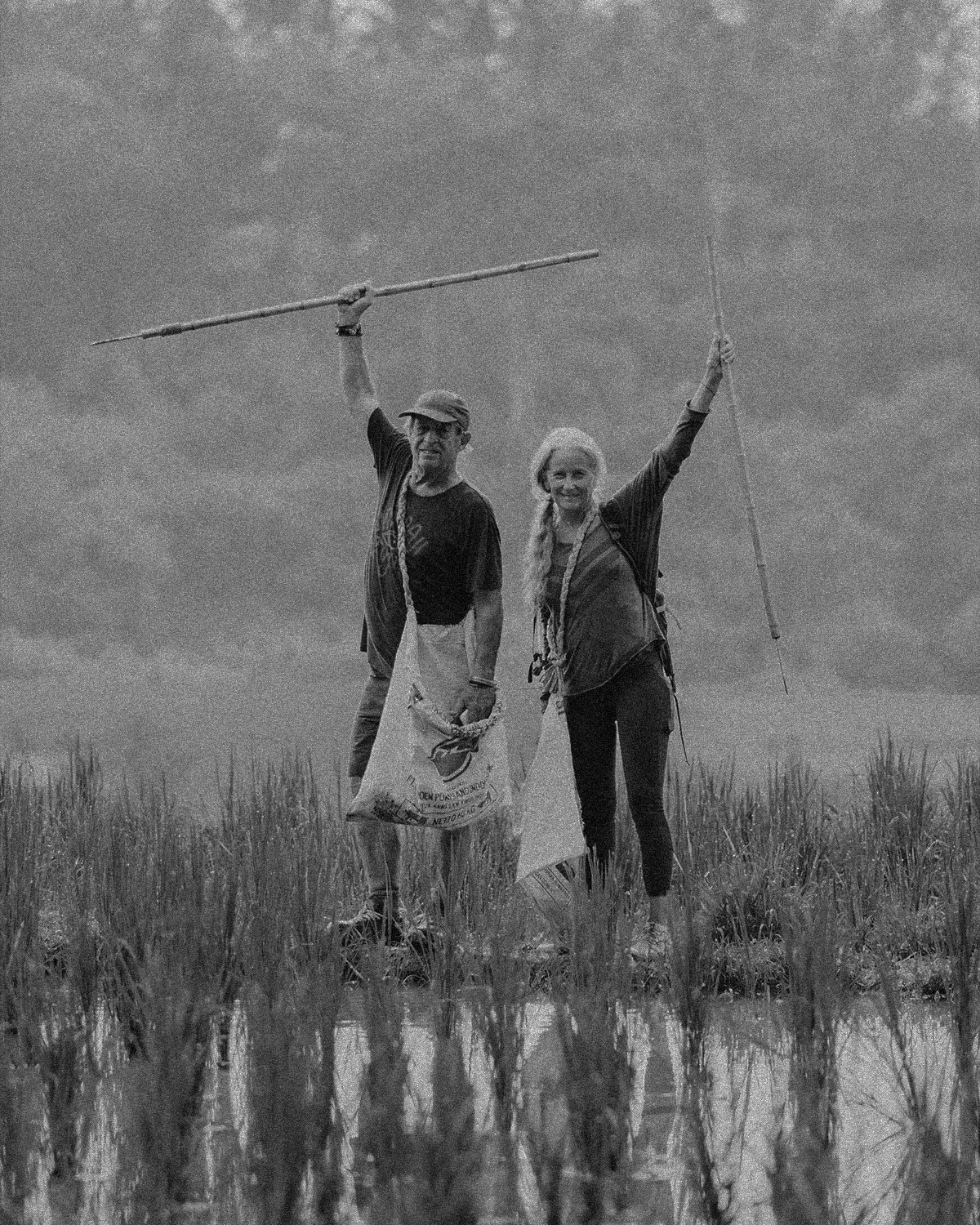
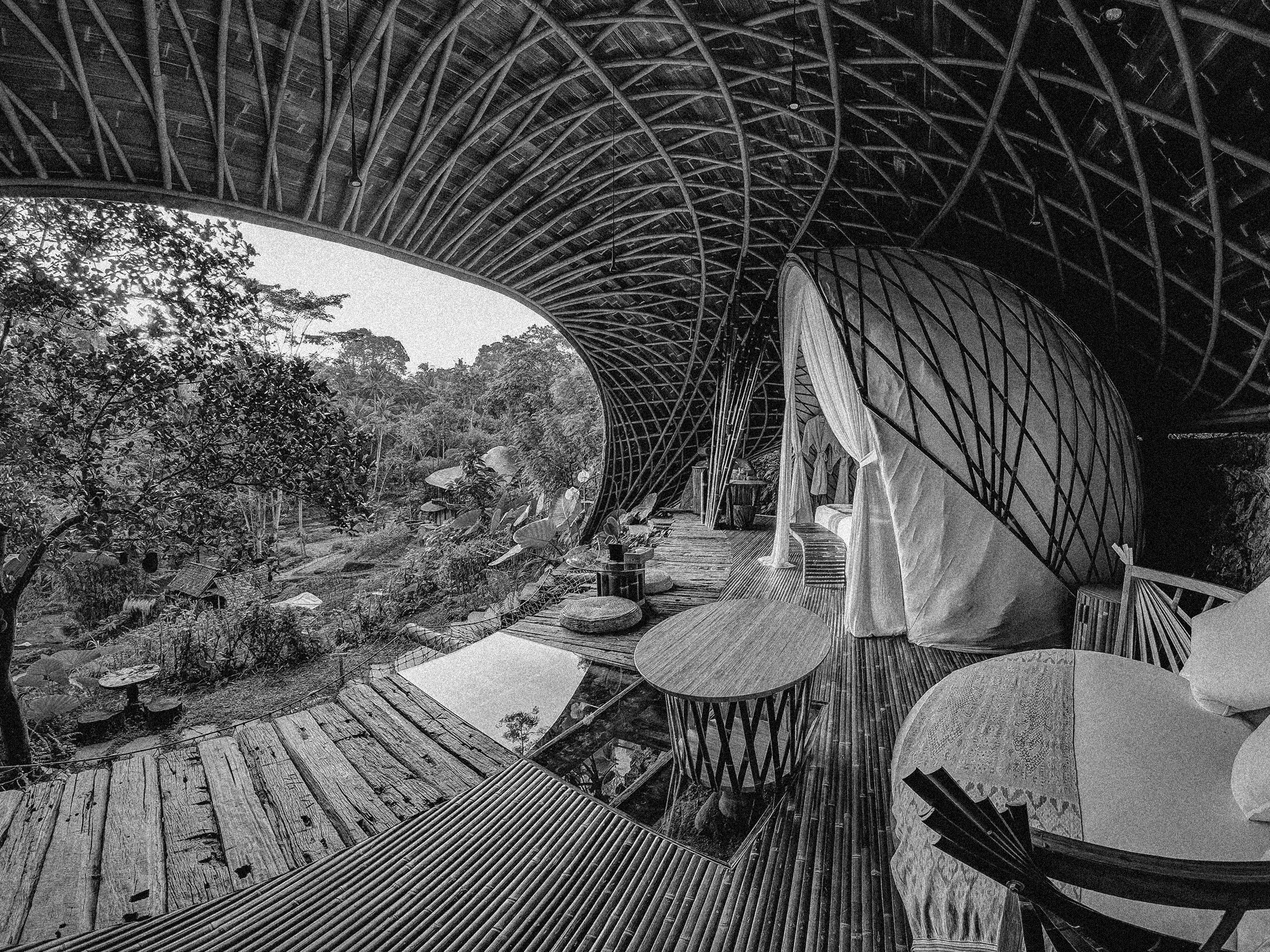
Bambu Indah began as what you've called an "accidental hotel." Before it became a hospitality business, what were you actually trying to create?
John & Cynthia Hardy:
We had guests, and we started putting some of them there because some guests wanted to be by themselves. It was an accidental hotel. We personally wanted to create space. The land became available in the early 2000s, and we didn't want a hotel built next to our house, so we bought the land and were very happy keeping it empty for many years. After many years, we decided to put old Javanese gladaks on that land, because we had guests who couldn't fit in our house.

You moved antique Javanese bridal homes to a ridge above the Ayung Valley long before sustainability became a trend. What did you see in those houses that others didn't?
Cynthia Hardy:
We saw beauty in raw, barren spaces. We saw old wood that had soul, feeling and grace. We saw roofs with beautiful peaks that were damaged but could easily be repaired. We saw the potential of living in very delicious, sexy, comfortable log cabins. We saw warm and cozy. We saw creature-comfort living in a nestled space.
John Hardy:
The Javanese houses were incredible because they were built when men were men and teak was teak. They were completely pegged and fitted together with intricate joints. The fact that they had been deserted for the concrete bunkers surrounding them made me want to save them. And the fact that the wood in them was cut by hand, with the knots split off, shows they came from the period before giant sawmills and the kind of ugly industrialisation that is spoiling our planet.
People often describe Bambu Indah as a hotel, but it feels more like an experiment. What question have you been trying to answer here for the last twenty years?
John & Cynthia Hardy:
How can we make our guests at the hotel feel like they're in our personal home? How can we share Bali through our eyes? How can we create an environment that comes full circle, for us and for them?
The question we've been trying to answer for the last twenty years, and still haven't been able to, is: how can this last?
How can the beauty of what we came to and experienced in the late '70s and early '80s go on forever? Because we don't see it as a trend.
We see that the farmers are getting old, and their kids don't want to farm.
We see crops failing, and the farmers don't have the right solution. Every solution we bring is merely another trial (and error), from making our own fertiliser and pesticides to releasing owls to hunt the rats. It's still almost impossible to grow a successful crop. The viruses are mutating, and the leafhoppers never give up.
We see the farmers exhausted.
And then there's the trash. However much trash we pick up on our trash walks, the problem can't be solved until everybody gets on board, from the government to the multinationals to the civic community. Everybody needs to understand that there's a future coming at us, and we're not doing enough to take care of the planet.
So our little trash walks are a nod to cleaning up the neighbourhood right now and doing the right thing. But they're not making much of a mark on the future of Bali.
So, how can Bali retain its magic?
We don't see it happening since COVID. So many people lost everything, and the Balinese are still trying to redefine tourism with things that aren't native to the island, like ATVs and swings. It may generate income, but in our opinion it doesn't help sustain what we saw when we first came to Bali.
People coming to Bali seem so attracted to what Bali was, but they're not really helping what Bali is and can be. They build concrete villas on the water tables, build golf courses that require huge amounts of water and pesticides, and create a kind of tourism that was never really here and doesn't help preserve the farming culture.
Many luxury hotels are designed to separate guests from nature. Bambu Indah seems designed to bring them closer to it. Why?
John & Cynthia Hardy:
Because all there is in Bali is nature. The religious beliefs of the Balinese are a form of nature worship. Without that, there is no Bali.
Immersing guests in the bamboo, the rice fields, the spring water and every living thing that is everywhere in Bali is the reason to be here.
It's very simple. There are ten million industrial hotels, and Bambu Indah's mission is to be a learning lab.
People want to be in a place that isn't encapsulated in cement.
People are hungry for nature, and there's no nature in industrial hotels.
I was always outdoors, on the beach, in the mountains or in the trees, and I have a deep adoration for nature.
It's in my ethos to be near and immersed in beauty, natural beauty.
Nature is a huge stimulus. We find it very healing for the soul to live in beauty, and that beauty is nature.
What was the moment when you realised sustainability wasn't enough and that regeneration needed to become the goal?
John & Cynthia Hardy:
Well, sustaining our behaviour is killing the planet. Paul Hawken wrote a book called Regeneration about the need to rebuild things. We can't just keep doing what we're doing. Sustainability isn't a very good word, because it means the status quo. I think the moment we realised this was in 2006, when we went to see Al Gore's film An Inconvenient Truth. We realised we were in a position to make a significant difference. We were leaving the jewellery business, and building Green School was an opportunity to really take a stand for the planet. Having lived in Bali as long as we have, with all the tools to make a difference, it became clear to us that regeneration, through building with natural materials and creating food systems, was the only way forward for ourselves and for future generations.
The Green School, bamboo architecture, regenerative agriculture and Bambu Indah all seem connected. How do they influence one another?
John & Cynthia Hardy:
Green School was created using many principles from Bambu Indah, and many principles from John Hardy.
We started building green. We started being green. We didn't want to promise the children concrete, or steel, or the last tree in the forest. We built it out of bamboo so they could have as much future as possible, because bamboo can be harvested every year.
Those companies are all independent, but very closely intertwined and interconnected.
Green School begat Green Village, which begat the Green Village restaurant and community centre, which begat Kul Kul Farm, the Bamboo U course that Orin runs, the ChopValue upcycled chopsticks company that Orin runs, the PT Bamboo building company that Orin runs, and Elora's architecture and design company, IBUKU.
It all started with an experiment by John and Yew Kuan in 2004, strongly influenced by our dear friend Linda Garland. One day John and Kuan held their hands together and made the shape of an ark: two interlocking shells, first made of bamboo sticks and ultimately of bamboo poles. It became a kind of church, which we now call the Kapal Bamboo, the store at the John Hardy workshop.
That was our first serious exploration of bamboo as something exquisite, not just functional.
I would say all of this inspiration came from John's early days living on a commune, wanting to innovate and be off the grid. John was an art student, a builder and a creator.
In 1990 and 1991, we lived in a little wooden shack below the Amandari. John built a little bamboo tree house for Elora and Orin, and a little bamboo kitchen in the trees.
It was our first house together, and we had no electricity and no running water. It was the house of the Amandari's project manager, which we rented for about a year: a concrete house with a thatched roof. This is where John first began exploring bamboo.
Tell us about a decision at Bambu Indah that people thought was crazy when you first introduced it.
John Hardy:
I built a house called the Moon House, which didn't have a wall, and everyone said no one would ever stay there.
But inside the Moon House, I built a kind of bubble that could be air-conditioned, which allowed people to stay there. It became the most popular house at Bambu Indah, and it still is.
People also thought the elevator was crazy. They had never seen an elevator like it in their lives.
We had a stairway up and down to the subak, but I realised that if we didn't have an actual elevator, people would say, "I won't go down there, because I won't be able to come back up."
A lot of people didn't want to walk down 108 steps.
The way I made it was also unusual. The elevator man came and said, "Well, it must be a metal box."
I said, "Have you ever been to a mine?"
He said, "No, I don't make mine elevators."
I said, "Thank you."
We got the type of elevator they use to bring materials and equipment up the side of a building while it's being built. Mines also use cages. They don't use boxes.


You have spent decades advocating for bamboo as a building material. What have people consistently misunderstood about bamboo?
John & Cynthia Hardy:
Everything. People think it wears out, gets tired, breaks, doesn't last, gets eaten by bugs, and is best used for scaffolding. Nobody understood what happens if you treat bamboo. The first bamboo we treated was with borax, and it's in the Tembaga restaurant. It's twenty-five years old, and not a single bug has ever gone near it. Borax treatment made bamboo a lifetime material. People are always surprised when I say this bamboo has been here for twenty-five years, because they just have this idea that it isn't strong. It's stronger than steel. People think it doesn't last, but we're proving otherwise all the time with these buildings that are twenty-five years old.
Bambu Indah sits in one of Bali's most beautiful landscapes. What responsibility comes with stewarding a place like this?
John & Cynthia Hardy:
Every responsibility you can imagine.
We want our guests to feel and appreciate the natural beauty that has existed here for centuries.
We want to have as little negative impact on the land as possible.
We have built all of our buildings off the ground, and they're easy to disassemble. Everything we've built here could be taken away in a few weeks, and the entire property could revert to the land as it was.
The responsibility is to educate people about what it takes to sustain all the systems around us, in particular the rice fields, which are an ongoing challenge.
There are so many problems in the rice fields: viruses, snails, rats, chemicals, water, climate, pests.
One responsibility we have, because we are a hotel, is to buy as much as we can from the farmers and support the local farming community as much as we can.
We spend a lot of money on food every day, and we want to channel that towards the farmers, so they start growing the food we need.
One of the questions we always ask ourselves is: how can we do it better?
Do we really need to buy bottled water? No. From the very beginning, we decided to harvest the spring water and clean it with reverse osmosis, silver and a natural filter, so that every room has access to clean drinking water. That's something rather unique.
We're trying our best to stay away from petrochemical oils and kerosene. The lamps around the property use used cooking oil, and the kitchen uses only coconut oil, extra virgin coconut oil and olive oil. We don't use toxic oils in the kitchen.
There's water, there's oil, and there's setting an example for others by building with natural materials.
Bambu Indah is crazy beautiful because we care about Bali, we care about the land, and we care about natural materials.
John will never make a straight line. When we were redesigning the upper part of Bambu Indah three years ago, he never went directly from A to B. He always made meandering paths, because he loves the experience of moving organically from one place to another.
Every hotel in the world has a hundred rooms that are the same.
At Bambu Indah, every room is an entirely different experience.
A huge number of people come here and have their first experience of a uniquely conceived and built wood or bamboo house, and that changes the way they think about building.
One of my responsibilities is creating an unforgettable experience.
That can mean walking into a room with old Caucasian carpets, sketches or paintings of people from Borneo with earrings hanging down to their shoulders, and only 250-year-old antique teak from Java. It can mean sitting on a bespoke sofa with hand-dyed linens, or bathing in a hand-hewn copper bathtub or copper rain shower that our team made while we were building the houses.
Exposing people to bespoke houses and bespoke experiences is one of our mandates.
Guests often arrive expecting luxury to look one way. What do you hope they have learned or unlearned by the time they leave?
John & Cynthia Hardy:
It's very simple. The longest and simplest story from any guest is: "We've stayed in a hundred hotels. We've stayed in three hundred hotels, and this hotel is different. So we like it better." Perhaps it's unexpected. Perhaps it's inconvenient. Perhaps it's the first time they've walked across a rice paddy to get to their room, on a path that doesn't go straight from A to B. Maybe the wood floor is a little creaky, or the air conditioning is focused mainly on the bed. Maybe all of that makes guests pause and wonder whether it's something they can get used to. It's a new experience. Try walking from A to B at Bambu Indah while looking at your phone. You have to put your phone down. We hope they have unlearned that everything needs to be perfect according to their expectations. That would be unlearning. As for the word luxury, we banned it from Bambu Indah. Are the Kardashians really luxurious? Bambu Indah is love and life.
Many of the ideas at Bambu Indah challenge modern convenience. Have there been moments where comfort and ecological responsibility have come into conflict?
Cynthia Hardy:
I don't think we've had any issues with a lack of comfort from providing spring-fed pools whose water comes right out of the earth.
I don't think anybody who comes here really misses a chlorine pool.
I think surprises like walking through a living rice field, instead of a flower garden, are quite a relief and a stimulus for guests.
Last year I was sitting on the Sunset Deck when a coconut in a tree, about thirty metres up, burst open because a squirrel had eaten a hole in it, even though it was protected by a net.
The net is there to stop the coconut falling on a guest's head. We net all of our coconuts. But who could have predicted a squirrel eating a hole in a coconut and coconut water dripping down on somebody's head? We put down a glass to catch the falling coconut nectar, and we enjoyed it very much.
I think that sometimes, if you apologise enough for things being inconvenient, guests find it charming, and they actually come around to loving the fact that inconvenience is sometimes fun.
Bambu Indah is also a non-smoking resort, which means no incense in the rooms, no burning candles, and certainly no cigarettes anywhere on the property.
We encourage guests who need to smoke to go and stand in the driveway.
That's certainly inconvenient and uncomfortable for them, but it makes things much more comfortable for the majority of people here who don't smoke.
John Hardy:
We have flush toilets, beautiful mattresses, soft pillows and linen sheets. We don't have much polyester. But we didn't make everything completely nanny-proof, stupid, flat and ugly. Simply put, you can't wander around Bambu Indah looking at your phone. You have to pay attention. And when people tune in and pay attention, it completely changes their headspace. Completely.


What has been the hardest lesson this land has taught you?
Cynthia Hardy:
The land is constantly evolving, as land does, with rain and wind and landslides and all sorts of things.
We are in nature.
The average hotel takes a bulldozer and destroys nature one hundred percent. If there's a slope, they make everything as flat as the architect's table.
We are living with change, and we have to adapt.
We have to be adaptable to keep nature alive.
Killing nature means there's nothing more to do.
The hardest lesson this land has taught us is that not all soils are created equal.
You can't just plant something in ground you don't know.
You don't know the soil's pH, or how much gravel or lava rock is in it.
It takes a long time to understand the soil and prepare it for planting different things.
The land has also taught us that intelligent, well-planned irrigation is critical.
If you don't have ditches in the right places, you've got a flood on your hands.
It has taken us years to engineer the best flow of water for the heavy rains.
And that flow of water is becoming unstable.
The land has taught us to live with it, not destroy it.
Very fortunately, we've survived hundreds of earthquakes since we've been here.
We've been living on this land, in our house, since 1994, and we've been very fortunate not to suffer in any of the earthquakes.
John Hardy:
We have a giant canal in front of us, hand-dug by men maybe a hundred years ago. It constantly washes away pieces of land, and there are landslides, so we have to be careful. But we also have to let nature be. It's like the bridges across the river. When the water rises really high, it pushes the bridges out, so we have them tethered so they can float until the water comes back down. Let nature be. Let's work with nature instead of destroying it with a concrete nightmare.
Looking around Bali today, what concerns you most about the future of tourism on the island?
Cynthia Hardy:
Overdevelopment and insufficient infrastructure. Mostly roads and garbage, and the lack of government oversight on limiting what people can build. The Balinese are generous and forgiving, and they are often taken advantage of. People are building on the land that feeds the people. Someday that land will be gone. And what will people eat? This is very short-term thinking by people who think they can just buy their food at the supermarket. Bali could turn into one big ATV park with no more rice fields, but then there would be no more tourism, because people came for the rice fields. The rice fields shouldn't be up for grabs. They shouldn't be sold. They shouldn't be built on. It's unfortunate that there aren't more controls.
What gives you hope?
Cynthia Hardy:
What gives me hope is Bambu Indah's resounding success, even though it's like nothing else. So many people come here and are influenced by Bambu Indah's presence and its place in nature. They leave saying, "I wish there were more of this. I want to build this. I want to create this somewhere else." What gives me hope is the younger generation of activists who are rising up and taking responsibility in Bali. What gives me hope is meeting so many guests who come to Bambu Indah and are inspired by what they see here. They take a bit of the change-maker in us home with them. They see what we've done in this beautiful place purely through our own will, and they go home and take a little more responsibility in their own communities. Of course, we hope they will come back to Bali and give back to Bali many times over.
John Hardy:
Bambu Indah gives me hope. People come here and are absolutely inspired. They constantly say that this is the way Bali should be. It's about taking a very light touch. It's about following the rules. It's about keeping Bali real and accessible.
Ten years from now, what would success look like, not just for Bambu Indah, but for Bali itself?
Cynthia Hardy:
To me, success for Bali, and also for Bambu Indah, looks like regenerative cultural tourism driving Bali and keeping it a rich, living, thriving culture.
That means all fertilisers and pesticides are natural, the grass is growing healthy, the rice is growing healthy, the vegetation is thriving, and there are permaculture models all around the island.
Everyone is using water from the water table, without plastic bottles delivered on large trucks.
The tourism that exists, which is obviously growing, will benefit Balinese culture.
It would look like a cross-pollination of education, with young people invested and involved in sharing Balinese culture with visitors, and making sure the benefits come back to the villages.
It certainly doesn't mean more golf courses, more concrete villas, more discos, karaoke or anything that remotely resembles a Disneyland in Bali.
Our true hope has to do with pride and ownership.
That the Balinese will take pride in everything they have and feel good that it's enough. They don't have to do more, and they don't have to create new businesses.
It's about finding a bridge between cultural tourism and the Balinese villagers actually benefiting from it.
An ideal dream for me would be to see visitors coming because they really want to learn how to weave a textile, throw a pot, paint a painting, weave a basket or make a piece of jewellery.
People would come and learn age-old crafts that are endangered from the Balinese, such as making a wooden mask, making offerings, or cooking.
My wish for Bali is that anybody who comes to visit comes because they really want to experience what Balinese culture is.
It's very rich, deep, involved and very spiritual.
It doesn't look like Disneyland.
John Hardy:
Ten years from now, I would hope the problem has become so serious that someone finally takes a stand: to stop indiscriminate building, to stop unlicensed development, and to stop the belief that anyone can build absolutely anything, anywhere.
That's not how it works in most parts of the world, especially in beautiful places like Italy or Vermont.
I would love to see another Bambu Indah somewhere else, to show people that this approach can be repeated.
If Bali had a light railway running around the island, it would completely change the traffic situation. People don't build ugly buildings along railway tracks, because the train doesn't stop and no one gets off. Along roads, however, every stretch becomes lined with whatever people decide to build.
Bali is a tiny island, only about 60 miles by 90 miles. Why in the world couldn't we preserve one island? Use it as a prototype for how many islands could be developed. Raise the money to do it properly.
What would happen if Bali were off the grid? It has abundant solar energy and geothermal potential.
What would happen if Bali were free of trash?
What would happen if every university in the world working to solve climate change opened a satellite campus in Bali and used it as a living laboratory to test new ideas?
What would happen if the corporations that blanket the world with harmful chemicals simply left Bali alone? What if they skipped this one place?
What if there were one small piece of land, just 60 by 90 miles, that wasn't sprayed and sprayed and sprayed? A place that remained organic, as it was for thousands of years.
Why do we have to have the same problems as the rest of the world?
EXPLORE THE PUNCH
Celebrating Remarkable
Businesses with Impact